Premier Executive Command OS
Dr James · BermudaA CEO’s whole operation on one screen, built inside the Microsoft 365 they already pay for.
Open it →Every competitor's phone is off right now.
Real number, real agent, real reply. Reset any time — .
No queue. No hold music.Start the clock and watch what happens.
Nobody chooses the dentist with the nicest website or the installer with the best reviews. They choose whoever picks up. And in most South African small businesses, the person who picks up is also the person doing the work — so half the time, nobody does.
It goes to voicemail. Almost nobody leaves one. You never learn it happened, so it never shows up as a problem — it just quietly shows up as a slower month.
By the time it lands, they've had two others. The Lead Response Management study — MIT's James Oldroyd with InsideSales, 15 000 leads and over 100 000 call attempts — found the odds of qualifying a lead fall twenty-one-fold between a five-minute reply and a thirty-minute one.
Rescheduling, reminders, chasing, re-typing the same details into three systems. None of it grows anything. All of it costs you evenings.
Three sliders. Move them to roughly match your business and see what the enquiries you never answered are worth.
That's roughly 6 jobs a month going to whoever answered first. Not lost to price. Lost to silence.
Nothing on this block is a statistic we are asserting. The sliders open on a plausible shape so the page isn't empty, and every vertical page has its own version with its own starting point. Move them to your figures and the number is yours — the only claim we make here is the multiplication. Where a real published figure is used anywhere on this site, it is named and sourced on the spot.
Generalists build you a chatbot. We've learnt how these four actually run — the language, the objections, the compliance, the way the money moves.
The trade that answers first gets the job.
The enquiry that waits two days instructs someone else.
An empty chair costs more than an empty inbox.
Every direct booking is a commission you keep.
Not "AI solutions". Specific systems that do a specific job, live in two to six weeks, with a person you can phone if they break.
Answers WhatsApp, web chat, forms and email in seconds. Screens, quotes, books. Hands you the ones worth your time.
Picks up the phone in your accent, takes the details, and sends you the summary before you've finished what you were doing.
The admin behind the admin — quoting, invoicing, reminders, handovers, the re-typing between systems that nobody should still be doing.
When off-the-shelf won't do it: a real application, built for how your business works. Eight to twelve weeks, milestone-billed.
We don't rip anything out or ask you to change how you work. We put something in front of the leaks and then we watch it.
We map where enquiries arrive, where they stall, and what that's costing in Rands. Free version takes a week. You keep the report either way.
Two to six weeks. You see it working on your own enquiries before it goes live, and you approve every word it says.
It starts answering. We watch every conversation for the first fortnight and correct it in public, not in a spreadsheet.
Monthly: what it caught, what it missed, what changed. It gets better because somebody is actually looking at it.
Awake AI is new. Most agencies would fill this space with stock logos and a made-up percentage. Instead, here's exactly what we measure from day one — and the moment there are real numbers from a real South African client, they go here with their name on them.
Eleven of them, and every one is real and running in your browser right now. No form, no email, no "book a demo to see the demo". Three are below; the rest are through the door.
Work a week of enquiries by hand while the job keeps pulling you away. Nobody clears it. Then watch the same week run itself, with your hands off the controls.
Colour in the springbok, the lion or the meerkat, tell the agent what you want behind them, and take the picture home.
A real stopwatch. Send one enquiry to your own business and to anyone you want to measure yourself against, then time who answers first.
Ranges rather than a single number, because a five-person practice and a forty-person firm aren't the same job. No "contact us for pricing" tier.
Not "live" as in a demo you can look at. Live as in answering your real enquiries, in your voice, on your real number. If we miss the thirtieth day for any reason that is ours, you do not pay for that month. We publish this because nobody else in this market will.
For the business whose main leak is simply not answering fast enough.
Reception plus voice plus the operations behind it. Where most clients land.
When what you need doesn't exist yet and buying it isn't an option.
You can absolutely buy a chatbot subscription for the price of a takeaway. It'll be live this afternoon, it'll answer generic questions, and it will be exactly as good as the hour you spend configuring it. For some businesses that's genuinely enough, and we'll say so on the call.
We map your actual enquiry flow, write what it says in your words, connect it to your diary and your systems, watch every conversation for a fortnight, and change it when it's wrong. It's the difference between owning a tool and having the job done.
Start with the audit. It's free, it takes a week, and you keep the report whether or not you ever work with us.
Above is the shape of it. The full catalogue lists every single thing we build — what it is, what it actually does, how long it takes and what it costs — plus the four pods you can buy it as, everything it plugs into, and an honest page on when you should hire somebody else instead of us.
Most agencies sell you "services" and then send an invoice every month for as long as you let them. We sell four named units with a duration, a team and a price on each one, so you know exactly what you have bought before you buy it. Open any of them to read the whole thing.
Filter it if you like, but nothing here is hidden behind a sales call. Each card opens to the full explanation — what it is, why it matters, and what it will and will not do.
Nobody wants a system that demands they abandon the diary, the CRM and the accounting package they have used for nine years. This sits on top of what you already have. And where the answer is genuinely a rebuild, we will say so rather than pretend a connector exists.
On models: we are not tied to one vendor. Claude, GPT and Gemini each do some things better than the others, and for legal and medical work we run open-weight models privately so content never leaves infrastructure you control. Which one is behind your build is a decision we make on the merits and tell you about, not a religion.
There are good firms in this market and some of them are a better fit for you than we are. Here is the honest version, including the cases where you should not phone us at all.
Eleven toys in the rack, every one of them switched on. Everything marked live is the real thing running in your browser — not a video, not a mock-up, and not something a salesperson has to unlock for you first. Have a go. Try to break it. Judge us on what you find rather than on what we say about ourselves.
Two of these four tiles are the real app, running. Not a screenshot.
A CEO’s whole operation on one screen, built inside the Microsoft 365 they already pay for.
Open it →Upload the plan, get the building. The geometry in the render is the geometry in the drawing.
Slide the proof →Fifteen screens of protocol, dosing and recovery — one app, not a dashboard bolted to a spreadsheet.
Demo being cut down for the browser.Arrived half-built across four partial saves. We worked out what it was meant to do and got it generating again.
Open a statement →Left, the plan that went in. Right, what came back.
Drag, or focus the slider and use the arrow keys.
Same screen, same numbers, no monthly slide deck. Dashed out because nobody is on it.
The four above are real and named with permission. What is missing is a measured before-and-after — that number belongs to the client, and none has published theirs yet. When one does, it goes here with their name on it.
If you would like that to be you: the first three businesses in each industry pay no setup fee and keep their founding rate for twelve months, in exchange for the case study, a Google review and two introductions. That is the whole deal, and it is on the pricing page with the other four.
Three things that tell you more than a testimonial would.
Message us and start a stopwatch. The number you get is the number your customers would get.
Everything in the Playground is running. If it's clunky, that tells you something real about how we build.
Published, in Rands, on the page. Anyone hiding their pricing is telling you something too.
Forty enquiries a month and four hundred are different systems. More volume usually means more edge cases, not just more messages.
WhatsApp alone is straightforward. WhatsApp plus phone plus three forms plus a shared inbox is a week of plumbing before anything clever happens.
A modern diary and a normal CRM: easy. A practice management system from 2009 with no API: not impossible, but honestly quoted.
Legal and medical work carries POPIA obligations and, often, private model hosting. It costs more because it should.
Every figure on this page is under what the rest of the South African market charges, and that is deliberate rather than desperate. We are new. The Results page is empty and we are not going to fill it with borrowed logos, so the only way we get real South African numbers on it is to be the obvious, easy, low-risk yes for the businesses who go first.
The honest version of the deal: help the business first and the rest follows. If your enquiries get answered, your diary fills and your admin stops eating your evenings, you tell someone. In industries where everybody knows everybody, that has always been worth more than a margin. We would rather be paid properly in three years by people who stayed than squeeze the first thirty.
Two things we will not pretend about. These are founding prices and they will go up as the case studies land — the businesses who come in now keep theirs for as long as they stay, and that is in writing. And cheap does not mean thin: the scope on this page is the same scope at any price, because a system that half works is worse than no system at all.
Do not take our word for it. Here is what we are priced against — published, with the sources, in August 2026.
| What you'd be buying | South African market | Awake AI |
|---|---|---|
| Self-serve WhatsApp bot you configure it |
R299 – R799 a month | We'll tell you to buy one if that's the honest answer |
| Packaged AI receptionist off the shelf, limited minutes |
R999 – R3 500 a month | — |
| Done-for-you AI reception built, connected and tuned |
R3 000 – R20 000 a month | R2 450 – R9 500 |
| Setup / implementation | R5 000 – R150 000 | R0 – R2 500 free for the first three in each industry |
| Advisory retainer consulting, not building |
R15 000 – R40 000 a month | — we build instead |
| Custom AI application | R75 000 – R200 000 | R45 000 – R280 000 |
| A human doing it receptionist or junior admin |
R8 000 – R15 000 a month business hours only |
Answers at 02:00 on a Sunday |
Sources, August 2026: BizAI (self-serve bots R299–R799, receptionists R999–R3 500, human receptionist R8 000–R15 000); BlueBird Digital (managed R3 000–R20 000 a month, setup R25 000–R150 000+, junior admin clerk R8 000–R15 000); Auto Alpha Advisory (professional setup R5 000–R30 000, advisory retainer R15 000–R40 000, custom agent R75 000–R200 000). Every figure above is theirs, not ours. If one of them has moved, tell us and we'll change the table.
Every engagement starts with the audit — free version in a week, paid deep version a flat R2 500 and credited in full against any build you go ahead with. It tells you where the money is leaking and what fixing it would cost. If the honest answer is that you don't need us, that's what it'll say.
These are not launch promotions. They are how we sell, permanently, and they exist because we audited the ten AI and development firms competing in South Africa and found that not one of them runs even a single offer like these.
Not live as in a demo you can look at. Live as in answering your real enquiries, in your voice, on your real number. If we miss the thirtieth day for any reason that is ours, you do not pay for that month.
The first three businesses in each industry pay R0 setup and keep their founding rate for twelve months. In exchange: a case study with the real numbers in it, a Google review, and an introduction to two people you rate.
The deep audit is a flat R2 500, and every rand of it is credited against any build you start within thirty days. You keep the report either way, including the part that says you do not need us.
Some businesses cannot carry the risk of a new system, and we would rather work than argue about it. A law firm starts paying the month its first AI-booked consultation lands. A trade runs a pilot month priced per recovered lead. A guesthouse prices the retainer against the OTA commission it stops paying.
Take the Growth Engine and the Marketing Engine together and both are ten percent off, permanently. Pay a year up front and two months are free. Refer a business that signs and your next month is free — there is no cap on that, and in industries where everyone knows everyone it is the only marketing that has ever really worked.
For years we ran campaigns for South African businesses and watched the same thing happen. The ads worked. The leads arrived. And then a good third of them simply evaporated between arriving and being answered.
Not because anyone was lazy. Because the person meant to answer was on a roof, in a patient's mouth, or in court. Because the enquiry came in at 20:40 on a Saturday. Because three quotes went out on Monday and ours was the second one.
You cannot fix that with more advertising. You fix it by putting something at the front door that never sleeps, never gets busy, and never forgets to follow up.
Most AI automation being sold here is repackaged from somewhere else — American playbooks, American assumptions, dollar pricing with a Rand conversion. It doesn't account for WhatsApp being the default channel, for load reduction, for medical aids, for POPIA, or for the fact that a South African customer can tell within one message whether they're talking to something local.
We're in Cape Town. We price in Rands. And we only take on four industries, because going deep in four beats being adequate in thirty.
We're not a reseller with a white-labelled chatbot. We're not going to tell you AI will transform your business. And we're not going to put logos on the results page that aren't ours. If a R299 tool would do the job, we'll say so on the call — we'd rather lose the sale than take a fee for something that won't move.
Cape Town, South Africa. We work across the country and with clients abroad, but the office and the humans are here.
…
You do not have to take our word for any of it. Everything in the Playground runs in your browser, right now, with no form in front of it.
Need to change it? Reply to the confirmation email, or send us a note and we will move it.
We process personal information on your behalf when we run an agent for you. You remain the responsible party under POPIA; we act as an operator. We don't sell data, we don't train public models on your customers' conversations, and you can have everything back or deleted whenever you ask.
Two things: what you deliberately type into the contact form, and what analytics records about your visit. Analytics runs on this site and sets two first-party cookies; what it collects and why is set out in our privacy notice. The calculator, the Playground and every tool here still run entirely in your browser and send us nothing.
The contact form only sends when you press send. What you typed goes to our own system so we can reply, and — because this is the thing we build — an agent reads it and answers you on the spot. If you pick a time, that call goes into our diary. We keep your name, contact details, what you wrote, the page you were on and the time you sent it, for twenty-four months or until you ask us to delete it. Pressing send also writes your IP address to a rate-limiting log, which is the one row a notice like this usually leaves out; the privacy notice sets out what is in that row, what has already been done to the addresses in it, and what is still to change. We do not sell any of it, we do not add you to a mailing list, and we do not train public models on it. Ask us and we will delete it. If you would rather send nothing at all, WhatsApp or email us directly instead — the details are on the contact page.
Conversation transcripts, the contact details a customer volunteers, and whatever the workflow needs to do its job — a booking, a quote, a callback. Retention is set per client, defaults to twelve months, and can be shorter.
Hosting region is agreed per client. For legal and medical work we can run models privately so that content never leaves infrastructure you control. Sub-processors are listed in your agreement and you're told before any of them change.
Access, correction, deletion and objection, as POPIA provides. We build the mechanism to action those requests into every deployment rather than leaving you to do it by hand.
You hear from us first, in plain language, with what we know and what we don't. We support your notification obligations to the Information Regulator and to affected people.
If something here isn't clear or isn't enough for your compliance officer, say so and we'll go through it properly. Contact us.
The contact form, and Google Analytics. Nothing else asks you for a character and nothing else keeps one. The calculator, the pricing tables, the articles and all eleven tools in the Playground run in your browser and send us nothing about you.
It will not send without a name and either an email address or a mobile number. That is not a dark pattern, it is arithmetic: without one of those we cannot reply, which is the only reason anybody fills in a contact form. Everything else is optional, and an empty field is sent as empty rather than guessed at.
Only the last three are not yours. page tells us whether you came from the
pricing page or from an article, which is genuinely useful when we write back and useless for
anything else. There is no tracking identifier anywhere in that form, nothing is read off your
device, and nothing is remembered between visits.
This is the part most privacy notices leave out, so it goes near the top instead. When the
form is submitted, the system receiving it writes one row to a rate-limiting log: your IP
address, one word for what happened to the request — accepted,
agent_reply, lead_send, rate_limited,
send_test or connection_test — and the time. That is the
entire row, and none of it is typed by you: all four columns are derived, which is the
opposite of the form fields above. It is what stops one machine firing a thousand
submissions at us overnight, and without it the form would need a CAPTCHA, which is worse
for you than this is.
What is actually in that log, written as it is rather than as it ought to be. It has been
running since 1 August 2026, and it is smaller than the paragraph above makes it sound:
of 589 rows, 492 are connection_test — a dashboard health check that was
publicly reachable until we closed it on 29 September. That much you can still check,
because the column it is counted from is untouched. The next three counts you cannot, and
you should know why: they were taken on 6 November 2026 from the address column, which
was erased the same day. The log held 85 distinct addresses, eight of which had ever
produced one of the outcomes a visitor can actually cause, and two rows, from two addresses,
were a visitor and nothing else. Those are also the three figures that flatter us most, so
it matters that you can tell which claims on this page are checkable and which are being
taken on trust. We would rather set it out that way than leave you reading the log as a list
of everyone who has been here, because that is not what it is.
Every address in it has been destroyed. On 6 November 2026 the address column was overwritten for all 589 rows — 1 August to 1 November, the entire history of the log. Not shortened, and not hashed: erased, which means unrecoverable with or without a key, by us or by anybody else. No rows were deleted, so the counts and the dates still stand and the rate limiter keeps its history. What it no longer has is the addresses.
What has not changed is what happens the next time somebody presses send. Until the replacement is deployed, a new submission still writes its address exactly as it arrives. That is the live position today, and it is the one sentence on this page most likely to go out of date.
What replaces it is written and tested but not yet running, so it is set down here as a
plan and not as a fact. The address will be turned into a keyed fingerprint as the row is
written — HMAC-SHA-256, with a secret this website does not hold, stored as
v1$ and sixty-four hex characters. That still catches one machine submitting a
thousand times, because the same address always produces the same fingerprint, while being
arithmetic nobody can run backwards into an address. Rows will be deleted automatically at
twelve months, by a job that runs daily rather than when somebody remembers. That work
belongs to the backend rather than to this website, and it will be described here in the
present tense on the day it goes live, not on the day it was agreed. You should be able to
tell a commitment from a fact on a page like this.
Reading the site logs nothing at all — it is pressing send that writes the row.
The first reply you get is written by an agent, not by a person. That is the thing we sell, and demonstrating it on our own enquiries is rather the point — but it means the text of your message is read by a language model, not simply stored and forwarded. A person sees it as well, usually within the hour. If you would rather no machine ever read what you write, send it on WhatsApp or by email instead. The details are at the bottom of this page, and nothing here forces you through the form.
Not a diagram of how a system like ours generally works. These are the five real systems, named, in the order they touch it.
Nothing else is in that chain. No CRM, no advertising platform, no lead marketplace, and no chat widget belonging to somebody else. If our backend is down the form does not swallow your message either — it hands the text back to you with a WhatsApp button and an email button so you can send it yourself, and in that case nothing reaches us until you choose to send it.
Section 21 of POPIA says that if somebody processes personal information on our behalf, there has to be a written agreement obliging them to keep it secure. It is not a formality: the Regulator enforced exactly that point against Dis-Chem. So the fair question to ask us is not whether we say nice things about security, but whether those agreements exist for the three companies named above.
Each of them publishes one that applies to an ordinary account without being separately negotiated. Supabase’s data processing addendum forms part of its terms of service. Twilio includes SendGrid’s inside its own terms. Google’s data processing terms are accepted automatically for new Analytics accounts, which this property — created in October 2026 — is. That is what those companies publish, read on 6 November 2026.
Now the honest limits of that answer, because this is exactly where a privacy page usually starts overclaiming. It is what the providers publish, not a lawyer’s reading of our particular accounts, and a separately signed contract would override it. Analytics is the awkward one of the three: depending on the data-sharing settings on the account, Google can be acting in its own right rather than purely on our instruction, which is a different relationship with a different answer. And none of us writing this is a lawyer. What we can tell you is who handles your information and on what published terms. Anyone who tells you more than that about their own compliance is guessing in a confident voice.
The database is a Supabase project in the us-east-1 region, which
is Northern Virginia, in the United States. So from the moment you press send, your name, your
contact details and the text of your message are stored outside the country.
Section 72 of POPIA sets conditions on sending personal information to a third country, and section 18 says you are entitled to be told that it is happening. You are being told. We are not going to dress it up as a feature: it is where the system we already run happens to live, a South African region is available from the same provider, and moving it is on the list.
The database is not the only part of this with an American provider, so it would be misleading to leave it there. The notification email is carried by SendGrid, a Twilio company, and it lands in a Google Workspace mailbox. The accurate summary is therefore not “one offshore database” — it is that an enquiry sent through this form is handled by American providers from the moment you press send.
What we can tell you is the shape of it: every provider in the chain is named on this page, there is no onward sub-processor we have not listed, and access at our end is limited to Awake AI’s own people. If your business has a policy against its enquiries sitting offshore, say so in the first message and we will tell you straight what we can and cannot keep in the country, which for a website enquiry today is not much. The fix is moving the database to the South African region the same provider already offers, and that is on the list rather than done.
Google Analytics 4 runs on every page of this site, property
G-YDVZ6VK0VX. A Google Tag Manager container, GTM-KNT6JJLN, is
installed beside it and currently holds no tags whatsoever — it is there so that an
advertising pixel can be added later without re-cutting the site. The day one is added, this
paragraph changes.
What Analytics gets is the ordinary set: which pages you looked at and in what order, roughly where in the world you are (worked out from your IP address by Google, and not stored by us), what device and browser you are on, and whether this is your first visit or your fifth. That last one needs two first-party cookies, and they are the only reason this site sets any.
Three events are reported by name. generate_lead when the form is sent,
book_appointment when a call is booked, and contact_click when you
tap a WhatsApp, phone or email link anywhere on the site. The third is the one worth spelling
out: we record that a WhatsApp tap happened, on which page, and the words that were on the
button. We do not get your number, and we never see the message you type afterwards. What you
say on WhatsApp is between you and whoever reads it at our end.
There is no cookie dialogue on this site, and that is a decision rather than an oversight. POPIA governs us, not the GDPR, and POPIA does not require a click-through consent box for analytics the way the EU’s cookie rules do. Beyond that, a banner would be the first thing a visitor meets on a site whose entire argument is that we do not put obstacles in front of people — and a box everybody dismisses in a quarter of a second collects a click, not a decision.
The straight version of what that means for you: measurement starts on the first page you load and you are not asked first. If you would rather it did not, block it. Any ad blocker, or a browser with tracking protection switched on, will stop it; every analytics call on this site is written to carry on quietly when the tag is missing, so nothing you can see will break. We would rather tell you how to turn it off than put a box in your way and call it permission.
One thing would change this. If we ever point Google Ads at visitors in the EU or the UK, consent rules apply that POPIA does not, and a banner goes up. We have not, and this page will say so on the day we do.
There are eleven working tools in the Playground — a colouring studio, a game, a POPIA readiness check, a solar sizing companion, a no-show estimator, and the rest. People use them before they trust us, which makes the honest answer about what they send home matter more here than anywhere else on the site.
Ten of the eleven send nothing and keep nothing. Not a cookie, not a stored key, not one network request. Your answers to the POPIA check, the figures you put into the estimator, the drawing you colour in — all of it lives in the tab and dies with it. We never see any of it. The honest cost of that is the other side of the same coin: we cannot get any of it back for you if you close the tab by accident.
The eleventh is the game. Awake Protocol remembers your aim setting, whether the music is on, and how many days in a row you have played, in your own browser’s storage. Those stay on your machine: the copy on this site has its server address deliberately pointed at nothing, so there is nowhere for a score to go even if it wanted to send one. Clear your site data and the streak goes with it.
This is checked on every build rather than remembered. The script that puts these tools on the site refuses to stage one that reaches for storage at all, and the game — the single exception — is checked instead for a live backend, which is what stops it quietly growing one.
Twenty-four months for an enquiry that never turned into work, set on 6 November 2026. Sooner whenever you ask, which takes one email and no reason. If you do become a client, your information stays while we are working together and then for whatever period the tax and companies legislation obliges us to keep records of the work.
And now the part these pages usually leave out. Nothing deletes anything automatically yet. There is no scheduled job quietly clearing out enquiries at twenty-four months, so for the moment that period is a commitment kept by hand, and a deletion request is what actually makes it happen on the day. It is the same gap as the IP log further up and it is being closed the same way. We would rather you knew which line on this page is enforced by code and which is enforced by us remembering.
The list of things we do not do is short and absolute. We do not sell your information. We do not share it with advertisers, data brokers or lead marketplaces. We do not pool one client’s data with another’s. And nobody outside Awake AI’s own people and the providers named on this page can reach it.
The mailing list deserves its own line, because it is the promise most often broken quietly. Enquiring does not put you on one. That is not a new sentence written for this page: the contact page has answered “Will I get put on a mailing list?” with “No. What you send is used to reply to you and nothing else” since the site went up, and there is no consent checkbox anywhere on this site to have pre-ticked in the first place. The law agrees with us rather than the other way round — section 69 of POPIA makes electronic direct marketing opt-in in South Africa, so an enquiry is not permission and an unsubscribe link at the bottom would not turn it into one. If marketing ever arrives from us, it is because you asked for it.
If something does go wrong, you hear from us in plain language with what we know and what we do not know yet, and we notify the Information Regulator where the Act requires it. We are not going to promise that nothing can ever go wrong, because nobody honest can.
All five are a one-line email to byron@awakeai.co.za. No form at our end, no fee, no reason required, and no account to log into. The formal routes exist as well and we are not going to hide them, but needing them against us would mean we had already failed.
The Information Regulator is the body that enforces POPIA in South Africa, and they do not need our permission to hear from you. Their details, read off their own contact page on 5 November 2026: Woodmead North Office Park, 54 Maxwell Drive, Woodmead, Johannesburg, 2191. enquiries@inforegulator.org.za · 010 023 5200 · 0800 017 160 toll free.
Worth knowing, since it affects whether you reach them: a good number of South African privacy policies still print a Braamfontein address and a complaints mailbox the Regulator has moved on from. Ours was checked against their own site on the date above. If a while has passed since then, trust theirs rather than ours.
Awake AI Automation & Development, Cape Town, Western Cape, South Africa. byron@awakeai.co.za, or WhatsApp +27 64 543 1411. Both reach the same person, and he is the one accountable for everything on this page.
Byron owns the business, which under POPIA makes him its Information Officer: the person answerable for what happens to your information, and the one the Regulator deals with.
We do not publish a street address, and the reason is worth saying out loud. There is no office you could visit — we work at your premises or remotely — and the registered address is a house. Printing somebody’s home address on a public page to make a company look more solid is not a trade we are willing to make. The two routes above are not a switchboard; they are the actual person.
This page covers what this website collects from you. What happens to your customers’ information when we run an agent inside your business is a different question with a different answer, and it has its own page: POPIA & your data.
Most of the AI automation sold into Cape Town was designed somewhere else. That is not a complaint about quality — a lot of it is good software. It is that the assumptions underneath it were made for a market where people email, where the power stays on, where one language is enough, and where GDPR is the law that matters. None of those four hold here, and the gap shows up in the places that cost money.
AI agents that answer your enquiries — on WhatsApp, on the phone, on your website and in your inbox — within seconds, at any hour, in your own words. They answer what they can, ask what they must, book the job in your diary, and hand you anything that needs a person. We also build the unglamorous half: the quoting, the invoicing, the follow-up that never happens and the re-typing between systems that eats a week.
The clients are small and mid-sized businesses across the city and the province — the CBD and Foreshore, the Southern Suburbs, the Northern Suburbs and Durbanville, the Atlantic Seaboard, Somerset West and the Winelands, and up the West Coast. Trades, professional services, practices and hospitality, mostly. If your enquiries arrive faster than people can answer them, that is the problem we work on.
Rarely on price. Almost always on silence. The message lands at twenty to eight on a weeknight or halfway through a Saturday, nobody sees it until Monday, and by Monday the customer has three quotes and a date booked with whoever replied first. Nothing about that was a pricing decision.
Two local things sharpen it. The first is the channel: this is a WhatsApp market, and a WhatsApp left unanswered for two hours reads as a business that is closed or does not want the work. The clock a customer runs on WhatsApp is not the clock an email runs on. The second is power. Load reduction still cuts supply across overloaded suburbs through the morning and evening peaks, and the evening peak is exactly when domestic enquiries arrive. An agent hosted properly keeps answering when your office cannot.
We have written up what the response-time research actually says — including what it does not claim, and why most of it describes a market that is not this one.
It is on the page, in Rands, like everything else we sell. AI reception starts at R2 450 a month, the full front desk at R5 900, and custom builds are scoped after a paid discovery phase rather than guessed at. The full price list is published because anybody hiding their pricing is telling you something.
Before any of that, there is a week-long audit that counts what actually reaches you and what gets answered, and puts a Rand figure on the gap using your numbers rather than ours. It is the cheapest thing we sell and it regularly ends the conversation, because a business already answering nine enquiries in ten inside ten minutes does not need us.
The quote that goes cold over a weekend, and what an unanswered site visit is worth once you put your own close rate against it.
Client intake when somebody has finally decided they need an attorney, and the POPIA dimension that is not optional in this profession.
After-hours calls nobody counts, the recall half of the same problem, and the medical aid question that makes it harder here.
Direct bookings against platform commission, and a season that arrives whether or not you are staffed for it.
Four things, and they are the reason imported playbooks underperform rather than fail outright. WhatsApp is the channel rather than a secondary one, so an agent has to be good there first and everywhere else second — including voice notes, which are normal here and which a surprising number of tools still cannot handle.
Language is not a translation setting. A customer who opens in English, slips into Afrikaans for a sentence and back again is not an edge case in this city, and an agent that resets or answers in the wrong one reads as foreign. Seasonality is sharper too: hospitality here has a December and January that arrive whether or not anybody is staffed for them, and the trades have a winter of geysers and leaks that does the same thing in reverse.
And POPIA governs the personal information arriving in every one of those conversations. It is not GDPR with the names changed, the transfer conditions bite the moment a supplier processes offshore, and the Information Regulator enforces it rather than the supplier’s terms of service. We set out the plain version in our POPIA guide and what we ourselves do with data on our POPIA page.
It matters for the things that need a room. A workshop where your team argues about what the agent should say is better in person, and the first fortnight of corrections goes faster when somebody can come and sit with the person actually fielding the calls. It matters for invoicing in Rands and for being in the same time zone when something breaks at five to five.
It does not matter for the software. Anyone telling you that AI built in Cape Town is technically better than AI built in Berlin is selling geography. What is actually different is the design decisions — which channel comes first, which law applies, what happens when the power goes — and a supplier anywhere could make those correctly if they understood the market. Most do not, which is the real argument, and it is a smaller one than it sounds.
We work with clients outside the country too, and we invoice some of them in dollars. Being here is a reason to trust the design, not a reason to pay more.
Open the Playground. It runs real working agents in your browser with no form, no email address and no “book a demo to see the demo”. If what you see there is not better than what you have, there is nothing for us to talk about.
Then read the thing that argues against us: when a cheap subscription chatbot is genuinely the better buy, including the thresholds that rule us out. Most small businesses in this city sit under at least one of them.
If you still want to talk, book a call or send a WhatsApp and start the clock on us. Seeing how quickly we answer is a more useful test than anything on this page.
Meta's rate card puts a South African utility message at $0.0095 and marketing at $0.0379. Here is that in Rands, and the part Meta does not charge.
9 min read15 articles, all of them written, all of them free to read without giving us anything. Every figure in them is either sourced against a named study or marked as your own number to fill in — we do not estimate on your behalf, and we do not publish percentages we cannot trace.
The WhatsApp Business API cost in South Africa is published by Meta, in public, down to four decimal places. Almost nobody quotes it correctly.
Here is the current number. A marketing message delivered to a South African number costs $0.0379. A utility message costs $0.0095. Meta publishes both on its own pricing page, they took effect on 1 October 2026, and the full rate card is a spreadsheet anyone can download.
Most local pages quoting this are wrong. They are wrong in one specific way: they are reading a card that has expired. This piece gives you the current figures, what they come to in Rands, the two cases where Meta charges nothing, and the new charge that appeared in July and that nobody here is talking about yet.
Meta charges per message delivered. Not per conversation. That changed on 1 July 2025 and it is the model today. You are charged when the message arrives, never when a customer messages you.
The rate depends on two things only. What kind of message it is, and which country the receiving number belongs to.
South Africa is a named market on Meta's card. There are 47 markets: 39 countries listed on their own, and eight "Rest of" regions for everywhere else. We are one of the 39.
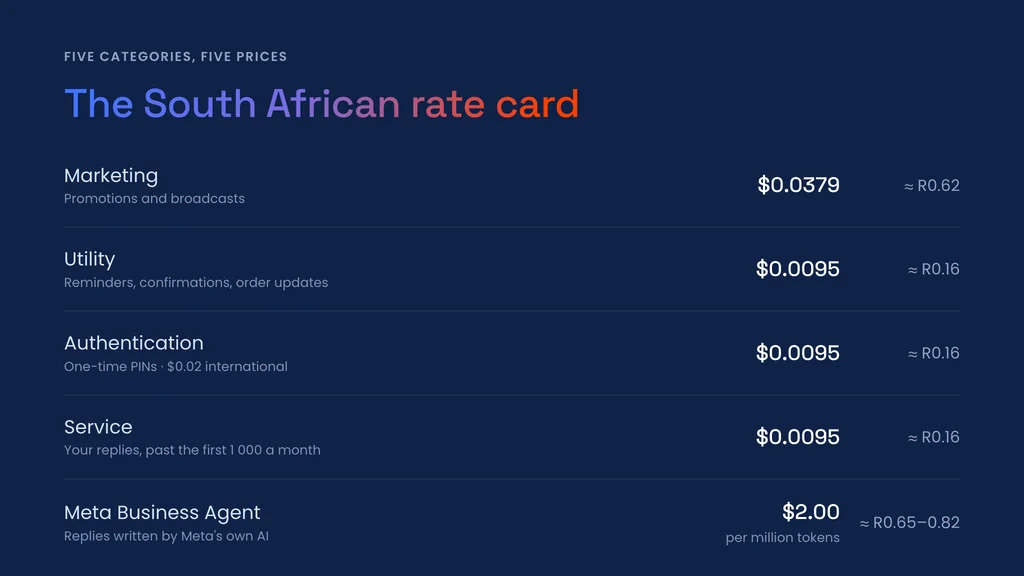
Five categories, five prices:
Being named on that card is not a discount. The same published card puts "Rest of Africa" at $0.004 for a utility message. We pay $0.0095. That is nearly two and a half times more, for the same message, because of the country code it lands on. Nigeria pays $0.0067. India pays $0.0014, which is where a lot of the "WhatsApp is practically free" advice comes from. It is nearly seven times cheaper there.
We are not the expensive end, though. The same published list puts the United Kingdom at $0.0635 for a marketing message and Brazil at $0.0625. Both are well above our $0.0379.
Because Meta reviews these rates four times a year, and half the pages were written before the last review.
Meta changes prices only on 1 January, 1 April, 1 July or 1 October, with at least a month's notice. That is a published rule, and it is the most useful thing to know about this whole subject. It means every quoted rate has a shelf life, and you can work out whether the one in front of you is still alive.
One South African page, published in June this year and still live today, puts our marketing rate at "roughly US $0.086 per message (around R1.50)". It was written in good faith. It is now 2.3 times the published figure.
That page then budgets an example: 5 000 marketing messages at R1.50, so R7 500 a month. At the current published rate the same 5 000 messages cost about R3 100. The example is not slightly out. It is more than double.
So the test is short. Find the date on the page. Then open Meta's own pricing page and compare. If the page is older than the last quarter boundary and quotes a number without a date beside it, treat the number as expired.
We will date ours too. Every figure here is the card effective 1 October 2026, read on 5 November 2026. If you are reading this after 1 January, check it.
At R16.3568 to the dollar, which is the South African Reserve Bank's published ZAR/USD rate on 5 November 2026:
Those are conversions, not quoted prices, and that distinction matters more than it sounds. Meta does not bill South African businesses in Rands.
There are 16 billing currencies on the platform. US dollars, euros, pounds, rupees, pesos, rand is not among them. You pick one when your messaging account is created, and once picked it cannot be changed without going through Meta's currency migration process.
So every rand figure you have ever been quoted for this — including the three above — is somebody's conversion at somebody's exchange rate on some day. The rate moves. Your invoice is in dollars. Over a year of broadcasts that gap is real money, and it belongs in the budget as a range rather than a number.
Meta's page is explicit about this, and it lists two cases.
The first is the free entry point window. If someone messages you from a click-to-WhatsApp ad on their phone, and you reply inside the service window, that reply is free and opens a window of up to seven days. While it is open, marketing, utility, authentication and service messages all cost nothing. Seven days. That is the single biggest lever on this bill and it is bought with an ad, not with a clever template.
The second is the first 1 000 service messages each month, per business phone number. They reset monthly and do not roll over. You are charged from the 1 001st.
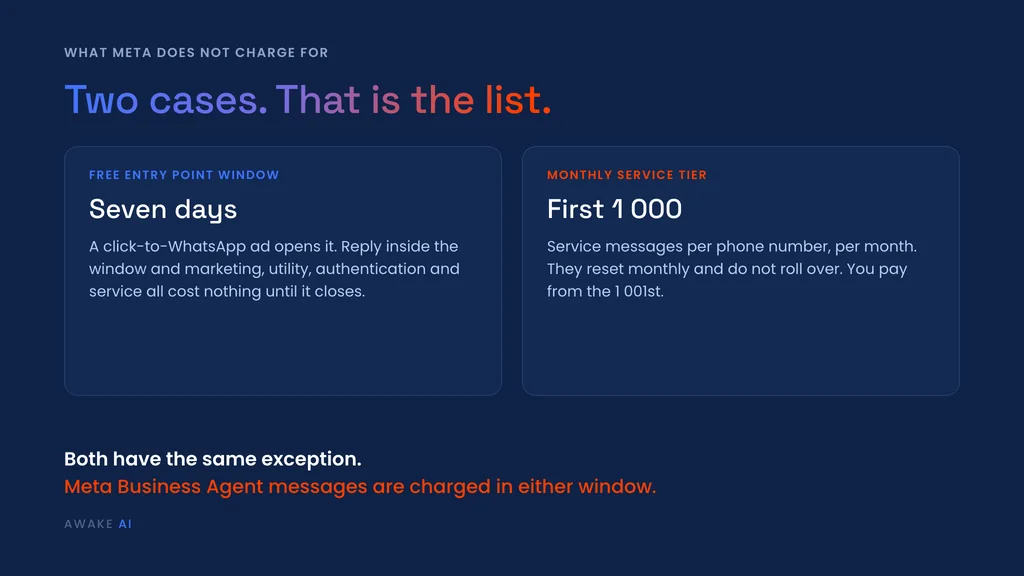
Both have the same exception. Meta Business Agent messages are charged anyway, in the free window and inside the free thousand.
And one thing is missing from that list. You will read, on local pages and in plenty of provider guides, that utility templates are free inside the 24-hour customer service window. That rule did exist. It is not one of the two cases Meta's current page lists, which was updated on 30 September 2026. If your provider still quotes it to you, ask them to point at where Meta says so today, and check your own invoice before you plan around it.
Pick your own volumes. The method matters more than our guesses, so these are illustrative, and the only numbers you should trust are the ones out of your own system.
A dental practice sending appointment reminders. Say 400 reminders in a month. Those are utility templates, at about R0.16 each. That is roughly R64 a month in Meta fees. Patients who reply are service messages, and the first 1 000 of those are free, so for most practices that side is nothing.
A solar installer chasing quotes. Say 150 quote follow-ups a month, sent as utility templates: about R24. Now add a marketing broadcast to 2 000 past customers at R0.62 each, and that one send is R1 240 — more than fifty times the entire reminder programme. Both volumes are your figures to replace, not ours.
That is the shape of almost every WhatsApp bill we have seen. The transactional side is cents. The broadcast side is where the money goes. If your quote surprises you, the marketing column is where to look first.
No. Not even slightly, and it is worth knowing why before a salesperson uses the word "tiers" on you.
Meta publishes a separate tier card, covering utility and authentication only. On the published South African tiers the first discount starts at 100 001 utility messages in a month, and it takes 5% off. The next needs a million. The largest discount, 25%, starts at 80 million messages a month.
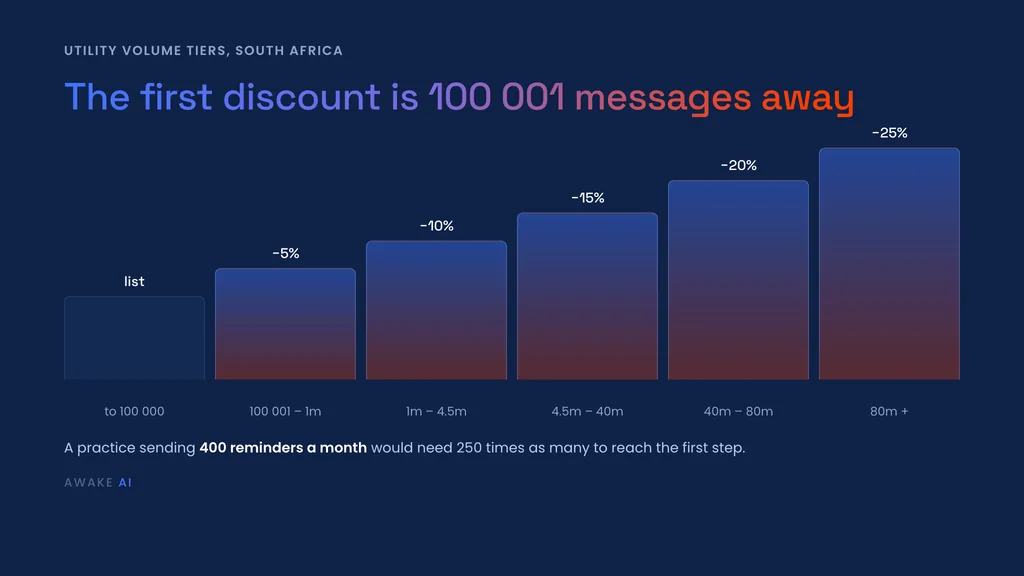
The practice sending 400 reminders a month would need to send 250 times as many to reach the first published step. A business doing a 2 000-person broadcast every week is still nowhere near it. These tiers were built for banks and retailers, and when you see a tier table used to argue that WhatsApp gets cheaper at scale, check which market's table it is. India's tiers start lower, and India's tables get copied a lot.
This is the part nobody local has written about yet, and it is the most commercially interesting thing on the card.
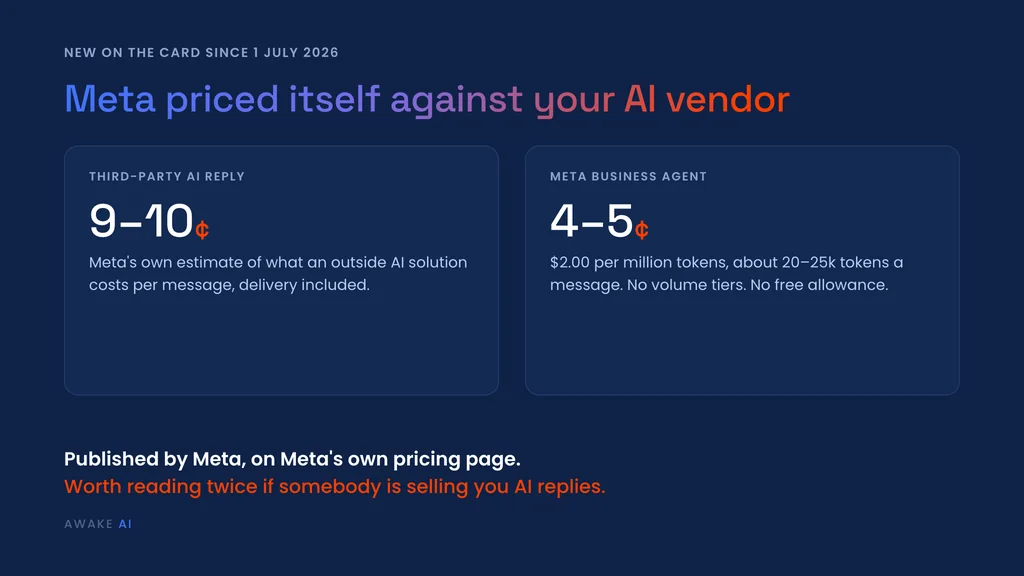
Since 1 July 2026 there is a fifth category. If an AI replies to your customers through Meta's own agent platform, that message is not billed as a service message. It is billed per token, at $2.00 per million, which Meta puts at roughly four to five US cents per message. About R0.65 to R0.82.
No volume tiers apply. The free thousand does not apply. The free entry point window does not apply.
Meta also publishes a comparison on the same page, and it is pointed. It puts a third-party AI reply at about nine to ten cents and its own at four to five. In other words, Meta has moved into the layer where AI answering services sit, and priced itself at half.
Here is the honest answer, and it works against us.
If all you need is a bot that answers questions in the chat, Meta's agent is likely to be the cheapest route you will find, and you should ask any vendor, including us, why their version is worth the difference. Our answer is in the difference between saying and doing, which we have written up separately — a reply that quotes your prices is not the same as one that opens your calendar, books the slot, writes it to your contacts and tells your team. Meta's agent lives inside WhatsApp. It does not touch your diary.
But if the job really is answering questions, take the cheaper thing. We say the same about R299 subscription tools, and the logic has not changed because the seller is bigger.
The rates above are what Meta charges. They are not what you pay.
Almost nobody connects to the API directly. You go through a provider, and the provider charges for the software — the shared inbox, the template builder, the broadcast tool, the automation. That is a separate monthly fee, and it is usually the larger half of the bill for a small business.
Three questions get you a real number, and any provider worth using will answer them in writing. Do you bill Meta's rates at cost, or with a markup? What is the monthly platform fee, and what happens to it if we double our volume? Your plan is priced in Rands and Meta bills in dollars, so who carries the exchange movement?
That third one is the question nobody asks. It is also where the margin usually sits.
For a small South African business doing ordinary transactional messaging — reminders, confirmations, replies — Meta's own fees are rarely the problem. A few hundred rand a month covers a lot of reminders. The platform fee and the broadcast volume are what decide your bill.
Three things move the number, in this order. How many marketing broadcasts you send, because they are four times the price of everything else. Which provider you are on, and what their markup is. And whether you are using click-to- WhatsApp ads, because that seven-day free window is the one discount a small business can actually reach.
And if you are not sending anything yet, do not start by buying a platform. Count how many enquiries reached you on WhatsApp last week, and how many waited more than an hour for a reply. That number tells you whether this is worth solving at all — it is the same count we run in the free audit, and you keep the report whether or not you work with us.
If you already know you need it answered properly, that is our reception service, the full ladder is the growth service, and what we charge is on the pricing page in Rands, where you can read it without booking anything. The rules on what you may automate on WhatsApp are the WhatsApp rules piece, and the alternative is priced in what an AI receptionist costs here. If you are storing what customers send you, the POPIA page covers the rest.
Every rate in this article comes from Meta's published card effective 1 October 2026, read on 5 November 2026, and the rand conversions use the Reserve Bank's rate on that date. Rates change on quarter boundaries. If you find one here that has gone stale, tell us and we will update it.
| Off-the-shelf tool | Built for you | |
|---|---|---|
| Live in | An afternoon | Two to six weeks |
| Monthly cost | R299 – R1 500 | R2 450 – R9 500 |
| Who configures it | You, in your evenings | Us, and we keep tuning it |
| Knows your prices & availability | Only what you paste in | Connected to your actual systems |
| Books into your diary | Sometimes, with add-ons | Yes, with your buffer rules |
| Phone calls | No | Yes, with Awake Voice |
| POPIA & private hosting | Generic terms, offshore | Agreed per client, SA-aware |
| When it gets something wrong | You find out from a customer | We're watching, and we fix it |
You're under about thirty enquiries a month, they arrive on one channel, the questions are simple and repetitive, and you enjoy tinkering. That's a real scenario and we'll say so on the call.
Your jobs are worth more than a few thousand Rand, enquiries come from everywhere, the answers depend on things only your systems know, or you're in a regulated industry. The maths gets obvious fast.